University of Tennessee Athletics
February 10, 2016 | Rowing
Feb. 10, 2016

- The Vols compete in the Big XII conference as affiliate members alongside fellow SEC member Alabama as well as Old Dominion, Kansas, Kansas State, Oklahoma, Texas and West Virginia.
- Volunteer Rowing competes in 2 seasons:
-
- Fall Head Races: 5,000-meter (~3.1 miles) time trial race, with 10-second intervals between boat starts. The course often consists of turns and bridges.
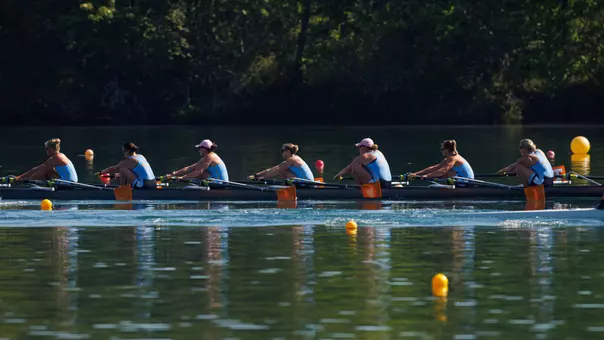
- Spring Sprint Race: 2,000-meter (~1.25 miles) head-to-head sprint race. The course is divided into 6-8 lanes and each 500-meter section is marked with buoys. All boats are evenly aligned at the start in the lanes they've been assigned. This is the NCAA Championship format race style.
- Sophomore rower Nicole Chojnacky was a Combat Medic in the military for 4 years and deployed to Bagram, Afghanistan from May 2013 through March 2014.
- There are only six basic boat configurations. Sweep rowers, who row with one oar, come in pairs (2-), fours (4+) and eights (8+). Scullers, who have 2 oars, row in singles (1x), doubles (2x) and quads (4x).
- A coxswain is the person who steers the boat and is the "on-the-water coach" for the crew. The team has between 5-10 coxswains. Coxswains are typically the smallest people on the team.
- A boat with 8 rowers and a coxswain, known as an eight, is about 60 feet long and weighs about 200 pounds.
- In an 8+, the first two seats (Stroke and 7) set the rhythm for the boat to follow, the middle four seats (6, 5, 4, and 3) are the "powerhouses" of the boat, and the last two seats (2 and bow) help to "set" or balance the boat.
- Sophomore rower Lauren Higdon was born in South Korea and has lived in 3 different countries and 4 different states.
- The Head of the Charles Regatta in Boston, Mass. is the largest boat race in the world, hosting over 11,000 athletes and 400,000 spectators during the 2-day event. The Vols have attended this prestigious race 15 times since 1995.
- To maintain cardiovascular fitness, the team rows on Concept II rowing machines, called ergometers, or "ergs" for short.
- Rowers tend to specialize rowing on a certain side: port or starboard. It is an advantage to have rowers who can row both sides!
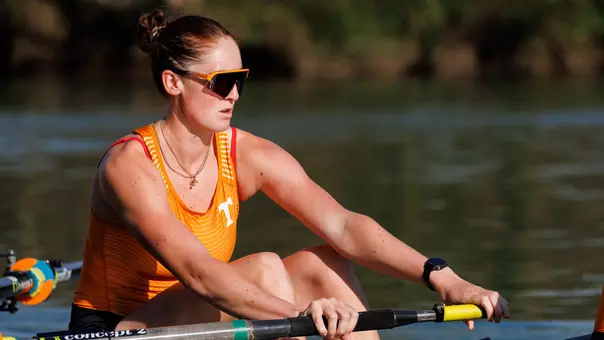
- Rowing is a total body workout. Rowing only looks like an upper body sport. Although upper body strength is important, the strength of the rowing stroke comes from the legs. Rowing is one of the few athletic activities that involve all of the body's major muscle groups.
- Senior Erin Gibbemeyer will graduate in May 2016 with a Veterinary Science degree and attend veterinary graduate school at either Virginia Tech or overseas.
- Rowing boats are called shells, and they're made of lightweight carbon fiber. Tennessee owns over 20 shells.
- Vol Rowing has boats named after prominent UT figures: Joan Cronan, Smokey, and The Torchbearer. Some of the smaller boats' names serve as an acronym that spells out VOLUNTEER!
- Rowers speak in terms of strokes per minute (SPM), literally the number of strokes the boat completes in a minute's time. In a spring race, a Tennessee boat will average around 38 spm.
- Rowing is a fitness-based sport with a skill component, which makes it the ultimate walk-on sport. Vol Rowing has a separate novice team dedicated entirely to first-year rowers who learn the basics before competing with Varsity during their second year of rowing.
- Senior Katie King has rowed for 10 years. Most rowers start rowing sometime during high school. King started in 7th grade.
- Both Tennessee Rowing assistant coaches, Sarah Arms and Chelsea Pemberton, rowed for Tennessee, graduating in '07 and '05, respectively.
- The Basler (pronounced BAY-zler) Boathouse is located on the river shore right behind Neyland Stadium!
- The team, during Spring 2016, practices at the boathouse on MWF 3:45-6:45 p.m., TR 7-9 a.m., and select Saturdays from 8:45-11:15. Come watch from Volunteer Landing or the Greenway!
- Rowers can run too! Every MLK Day, the rowing team runs a 7-mile "Pancake Run" throughout downtown Knoxville and UT campus, celebrating with a team breakfast afterwards.
- Shells don't move like a car -- they're slowest at the catch (when the oar enters the water), quickest at the release (when the oar exits the water). The good crews time the catch at just the right moment to maintain the speed of the shell.
- A 2,000-meter rowing race in an eight typically lasts between 6 to 8 minutes depending on weather conditions, water current, and crew speed.
- Women rowers compete at the NCAA Rowing Championships in a Varsity 8+, a Second Varsity 8+, and a Varsity 4+.
Players Mentioned




Friday, May 22
Thursday, May 22
Thursday, August 15
Thursday, February 01