University of Tennessee Athletics
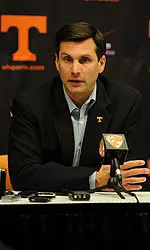
Derek Dooley Media Luncheon Transcript
October 25, 2010 | Football
Oct. 25, 2010
"All right. Just reviewing that Alabama game, obviously a disappointing end result but there were a lot of good things we can build on and then there were a lot of things that are concerns and have been concerns all season. I think first off, if you look at it offensively, just the fact that we had a back rush for 100 yards; I think it was 41 games (since Alabama had allowed a 100-yard rusher). That's a positive sign.
"I was real pleased with the drive right before the half. We had a good opener in the first quarter, then we got into that second-quarter rut. But we had about a seven-play drive there with about a minute to go and got points. I think that was really encouraging.
"In the second half, we had a 10-play drive, a nine-play drive, an eight-play drive to start the third quarter. And even though Alabama was scoring, we had an opportunity to answer the bell. But that brings you to the real disappointing part -- our ability to finish those drives.
"We get to about the 32-yard line the first drive; we come out with no points. We get to the 10-yard line the second drive, come out with no points. And then we were down in the red area again and got no points. We're down there three times. If you get your goal, which is two out of thee touchdowns, that's 17 more points. But I think not finishing those drives, the psychology gets into it. So that was disappointing.
"On the defensive end, it was really a tale of big plays. I think they had about 69 plays in the game. For 61 of them, we held them to 230 yards. For eight of them, we held them to 300 yards. That's not good.
"A lot of balls over our head, long runs -- certainly it's a great team and some great players. But we didn't do our part as it relates to mental errors and trusting your technique and competing on those plays. That was disappointing. That's what ultimately was the difference in the game, those big chunk plays they had.
"Looking forward, the biggest thing we have to do is improve our stamina -- physically, emotionally, intellectually. The deeper the game goes, continue to trust in your technique, keep competing and not let anything break down. That's not what we're doing right now. (We're) not playing as confident consistently as I'd like, although there were a lot of times in the game that we did.
"This opponent we're playing this week, it's probably the best team they've had, certainly since `01. Defensively, they remind you of `The Swarm' in the 80's. I don't know if you all remember them. I remember them because we played. They're fast and they're physical. They run to the football. They fly around.
"The formula on any good offense is great runner, great receivers and a quarterback who's playing really well. And they've got all three. That's a formula for having a good offense. It doesn't matter what offense you run. If you've got a great quarterback, a great runner and a great receiver, you're going to move the ball and score points. And that's what they're doing. Haven't lost a game at their house, so we've got a heck of a challenge. It doesn't get any easier, even though some people think we're out of the woods.
"Injuries, not a lot new. (Marsalis) Teague, he's the only guy that really I'm a little concerned about. He's a day-to-day guy. He's got a toe. It doesn't seem like a lot, but sometimes when you've got to run and cut, a toe can be a real nagging injury. It's kind of a turf toe deal, which is like a sprain. Daniel Lincoln, I don't know. We'll find out later in the week. And all the other usual suspects are still out for now."
If you don't have Marsalis, what will you do there?
"Well, we've talked about a lot of things. I don't think we have an answer right now. We might have to rep a safety over at corner some. (Brent) Brewer played a little bit better, and he played for the first time. And he did some good things. It doesn't mean he can be our guy at safety, but at least it gives you a little bit of encouragement. Maybe you can mix it up some.
"But there are just not a lot of different options. We're not playing to our potential in the back end at every position, which is another concern. It's going to be a tricky puzzle."
Maybe optimistic that Naz (Oliver) can maybe start practicing this week?
"I don't think there's any chance he'll play in the game, from what Jason's telling me. There's a chance he could play the next week, but we'll get him out there in practice and see."
On quarterback situation:
"I think it's too early to tell. The chances are we'll maybe stick with the same plan. But I think it's too early to tell. Matt (Sims) is a little dinged up. He got hit a few times. We'll just see how they do in practice today and tomorrow and the next day, and then we'll figure it out by the end of the week."
Some would say why isn't that stamina there seven games in. Is it directly a result of youth?
"I don't think it's a conditioning -- it's not a physical conditioning issue when I say the word `stamina.' It's really more mental. It's psychological. It's emotional. It's intellectual. And it's just an ability to focus for four quarters.
"It's not just youth. There's so much inexperience. We have juniors out there that have never played before. So there's a little bit of, `Well, they're young.' It's not so much in the years as much as it is in the games played. We have a senior offensive lineman, but coming into the season he started three times. I think experience is really a better word than youth."
Would you expect that to get better as you get into November?
"It should, it should -- if we're doing a good job of coaching and the players are responding. My history in this structure is you get stronger as the year goes. Where that hasn't happened in my past -- and I'm really speaking of the eight years not counting the NFL -- where we didn't get stronger later in the year was a result of a lot of injuries happening and that affected the roster.
"But I think if you just continue to work and hit and push and coach and focus on the day, you should get better. But the mental psyche is a real key to that. You have to keep believing and stay confident and not get affected by the results. And that's the challenge."
Where is that psyche?
"I don't know, I don't know. I think the psyche was good Saturday. We went out there and competed. The psyche gets a little tough when a couple bad events happen and we don't answer the bell. I think that's shown. When you play a really good team and they do some things to you and then you can't answer real quick and then you start getting like this. We need to work on that."
What's the difference in going through it with a young team?
"Inexperience."
I'm sorry, going through an SEC with an inexperienced team as opposed to at Tech going through the WAC schedule?
"There are some differences. There's four top-10ers you're playing. Let me say it this way: Probably the biggest difference is the expectations on the program. I don't think like relative to your competition the difference is as glaring. We went and played Boise and Nevada and Fresno, relative to them, it was tough. That isn't different.
"I think what's different is this is new to Tennessee, the results. It's certainly new to you guys. It's new to the fans. The players didn't come here thinking it would be like this. I mean, let's just call it like it is. When I was at Tech, it was pretty typical. So you're trying to get them to do something they hadn't done, if that makes sense. Here, you're dealing with a little different mental state."
Does that contribute when things go bad, maybe the old Super Bowl syndrome of when they falter in the Super Bowl they just kind of unravel?
"I think when you're strictly focused on the results - I want to win -- and not on the competition, I think that's when it happens. I think our team in many ways has done that. We're so caught into the results. And then when it looks like, `Uh-oh, it's not going our way....'
"Now we haven't done that every game. And hey, Alabama, they overwhelmed us there, and we couldn't answer the bell. I don't think we shut it down; I really don't. That's what happens. And I think that's what happens in Super Bowls. You want to win so badly, and then all of a sudden things go bad -- `Oh, we've come this far and we're not going to do it.' Then you quit competing. You almost wish you could just put a cover on the score and not tell them. Tell them all the time it's tied. Even though they just hit three touchdowns, it's tied. That's all I was doing, `Guys, let's win the fourth quarter. Let's win the fourth quarter. Forget about.' Of course, I'm talking about a result."
Your first half, you've been competitive with about everybody.
"Except Georgia."
Right. The second half, not so much. You've been outscored significantly. Do you like where you are with your game plans going in, and then what do you think is happening in the second half?
"Well, I think it's a lot of things. I think the stamina issue, the experience. During the course of the game, the game always gets hard. It always gets harder. The plays you were hitting earlier, they're making adjustments and you're not hitting them. When you're stopping them early, they're going to make adjustments and you've got to be ready to react.
"The second thing is -- and this is really what I saw in the Alabama game -- it's the same stuff over and over. You've got to have the physical and mental and emotional stamina to do it again and again and again and again. Holding the B-gap, running to the ball, whatever it is -- that's what good teams do to you. They don't do a lot of, `Oh they're stopping this, do this.' It's more, `We're coming.' And you've got to stop it for four quarters."
Are you limited in your halftime adjustments because of experience?
"I don't think so. As a veteran team, are you able to do more? Of course you are. Are you able to carry more in a game plan? Of course you are. But it's not like that's the reason we're not playing well in the second half, I don't think."
Is it depth more than inexperience in the second half?
"I think depth's a factor. I think experience is a factor. We've obviously got to do better as coaches. That's No. 1; it always is.
"But you know, we come out in the Bama game, we've got two balls thrown over our head and then we seem to make more mistakes as the game goes. We're about to cut the game back to one score and we have a couple of bad mental errors. We get down to the 30; we have to kick a long field goal.
"Then we come back down, we're down 17 and we're on the 10-yard line. So worst-case scenario, we're still two scores down. Third quarter, we're fine. Best-case scenario, we score a touchdown and it's a 10-point game, we're in great shape. And we make a real bad decision. It seems like some of the mistakes -- just like the big plays in the first half.
"They had three plays for 100 yards in the first half. Still too many, but we had a ball go over our head. We had a 42-yard run where we had a bunch of misaligns and we had a tunnel screen on third-and-14. Those were the bad plays. But all the other plays were good, it's 13-10. Then the second half, we have five for 200. So the mistakes get greater in the second half. I don't know why. We've got to coach it better."
You talk about getting it thrown over your head - and I'm not saying you wanted to bench Art (Evans) or anybody - but what options do you even have? It's not like you can say, `It's not working with this guy; let's try it with another guy.'
"Well, I think you've got to coach and trust your technique. If a guy plays perfect technique and the other team makes a play, OK. That's not the case most of the time. Most of the time we're affected in some way, and we don't trust our technique. We get a little nervous or don't know. Then it looks worse. You've got to keep coaching technique, process. `This is what you're supposed to do. Did you do it on this play?' `No I didn't, coach.' `Well, this is what happened.' There's a consequence."
How much have you coached with two quarterbacks, and how will you manage that going forward?
"It's hard. It's not what you want as a coach because you can never win. The only way you win is if both quarterbacks play great and you win the game. That never happens.
"If one guy plays well early and you put the other guy in, well, we screwed up the rhythm. If one guy plays poorly early and you put the other guy in, well he never had a chance to play into the game.
"I mean, you can't win. But I just feel like sometimes you have to do it. You have to do it to help win the game."
What did Tyler Bray show you guys and are you happy with your decision to play him?
"Yeah, I think we are. I am. He got experience. I don't think looking back we would have won the game had we not played him. He put together some nice drives late in the game and didn't finish them off, which is what Matt did -- put together some nice drives and didn't finish them off."
Do you find yourself coaching more technique at this point in the season than maybe you have in the past? If so, how frustrating is that?
"It's not frustrating. That's our job. I tell our coaches that, why are you mad? If these guys could do it, we wouldn't have a job. You'd have one coach to say, `Hey, go run a post route.' You ought to be happy they can't do it because they need a coach.
"If they could just do it and you're great, what kind of satisfaction do you get out of coaching? So you really ought to look at it like, these guys need you, let's go get them right. And then when they do well, you'll feel good about it. That's how I view it. But I always look at it a little backwards."
Because of the inexperience thing, are you doing it maybe more at this point in the season?
"On fundamentals? Is that what you're getting at?"
Exactly.
"Yeah, I think when you have a younger, inexperienced team you're always going to work fundamentals a little bit more. I've made that comment; we could have three spring practices. We need them."
Would you put Alshon Jeffery in the same category as Julio Jones and A.J. Green?
"We've seen some good ones. A.J., Julio -- and here comes another one. And this quarterback is playing better consistently than any of the quarterbacks we've faced. And then they've got a runner who got good and oiled up this weekend. Probably got massaged, you know. He's stretching, got a chiropractor on him getting ready for the Tennessee game. Watching the film, licking his chops, can't wait.
"They're just going to be arguing with the head coach on whether to run it or throw it because both of them look good. `We ought to run it, coach. Look at the film.' `I know, but have you seen the film on throwing it?' What we're hoping is they start arguing a little bit about what to do."
Back to that WAC comparison when you were at Louisiana Tech. What were the fans' expectations in those games against the better teams: Nevada, Fresno? Did they not expect to be that competitive against them?
"I think like all fans, the expectations are always higher than what is realistic. And that's what fans should have. But I think they had a greater history of not playing well in some of those games. There was a greater history of getting run out of the stadium on games when things went bad. Even though there was a lot of `Hey, we expect you to do well,' when it happened, well, that happens a lot.
"Whereas here, I get reminded every week this is the first time since some Stone Age that this happened. It hasn't happened a lot here. So that's the difference. This is new. We're in uncharted waters."
Do you think those players at Tech tended to be more relaxed and maybe more resilient because of that and had less chance of getting frustrated?
"Yeah, but there's also a downside to it because there's an acceptance. That's what can never happen, and we can't allow that to happen on our team. That you accept, `Well, that's who we are.' It worries me that we talk about we're inexperienced, we're not very deep and then players, `Well...' It's an excuse not to win, and it can't ever get that way. It's inexcusable.
"I tell our team all the time -- we'll never compromise the standard, and we won't. It doesn't matter what the situation is. The standards are the standards. That's the caution. Because even though they're used to it, then you're looking for ways to lose the game. And that's a hard culture to change."
Matt Simms said he didn't think anybody deserved to take his spot. Do you like his competitive spirit? Or would you rather him keep that in house?
"I think the competitive side of Matt is that's what it should be. I think that Matt has really good character, and the team part of him understands what we're doing and why we're doing it. I wouldn't want him to agree with me by saying you need to get me out of the game. We'll try to contain his competitive side with you guys a little bit better. I need to talk to him before the end of practice, so he'll come out with a canned -- you know those canned, `I'm all for what the coach says. I'm a team player.'
"But let's call it like it is. If you don't have a little selfish in you -- there's not a competitor out there that doesn't have it. I had it as a player. I mean, I was throwing pads in my locker when I thought they should have called a play for me to score a touchdown. But you've got to learn team."
You talked last week in practice about re-establishing the brand of competition and how you want these guys to play. What is your evaluation of that?
"I thought so. I did. I don't think anybody goes out there and says, `We laid an egg against Alabama.' Now when you look at the score it looks that way."
When it comes to experience, is part of that being self-sufficient and having a little more responsibility in those kinds of situations?
"I think it comes with experience, and we've got to keep coaching it. You coach them so that, No. 1, they're not afraid to go out there. I think a lot of it is when you're new and you're young, you're afraid. You don't want to mess up. When the bullets are flying, you vapor-lock sometimes.
"You saw it in that little offensive series. It's just a lot of -- I want to go up to them sometimes when it's like that and go, `What's your name?' `Yes, sir!' Relax, and think, and compete. It just comes with experience. Going out there when you hit the field and you just feel calm and confident, I belong here. You're not afraid to take ownership in the decision.
"Right now, we're like the Germans in World War II, all right? Here come the boats. It's coming. The binoculars, like, `Oh my God, the invasion is coming.' That's what they were doing. They were in the bunkers. `It's coming.' They call Rommel. They can't find Rommel. `What do we do? I'm not doing anything until we get orders. Have you gotten Rommel yet?'
"The Americans were the exact opposite. We hit the beach, and we're on the wrong spot, what do we do? I don't know, but these guys are firing, we better hide over there and blow some stuff up to get up there. They weren't looking for (orders). So we've got to make that transition.
"I don't want the German people to get upset at me. I'm not attacking. But that's what happened. You had one group, they weren't worried about what the plan was, what the orders were. When the war hit, things change. You've got to go. You've got another group, now wait a minute, they told us the invasion was way further north, where we had the empty tanks and were hiding Patton out. `We weren't ready for this. What do we do? Well, we better wait until Rommel tells us what to do.'
"(Laughs) I hope I got my names right."
You did.
"(Laughs) What, are you like the king historian around here? Huh? All right, history minor at Tennessee."
You've now got three true freshmen on the offensive line.
"They're playing real well. Now that (JerQuari) Schofield's back -- now is he back 100 percent? No. Don't forget, he's a freshman -- but we'll probably let him integrate back in with (Jarrod) Shaw at left guard, which will bring us back to where we were in the beginning working (James) Stone in at center. That's probably where we'll head this week.
"I'll tell you, Zach Fulton played a phenomenal football game. He was one of our players of the week, him and Poole on offense. I mean really went out there and competed against some great football players, went toe-to-toe with them. Ja'Wuan (James), we all know he's doing well. So I think those guys in time are going to be good football players."
Who were your defensive players of the week?
"Nick Reveiz, and Chad Cunningham on special teams."
The substitution issue, it's four weeks in a row now you've guys have issues.
"Here's what we're doing. These are all firsts. I'm doing something I never have done in coaching. But whoever's on the field when we go field-goal block, that's who's running field-goal block. All my years, we substituted like a special team where you go try to block it. Our goal on field-goal block this week is to have 11 men on the field. Now we're going to have to teach them all what to do and all that. Probably won't block the kick.
So you're not substituting at all.
"That's the goal. If so, it may be one guy. We'll see where they line up. I don't know where they're going to line up.
"Some programs do it like that. I've always wanted to go try to pluck one. Be aggressive. And we've had a lot of success blocking field goals. But to do that, you have to substitute people and get your best rushers, edge guys, who's your slant technique guy, who's your edge rusher? Everybody's got different qualities they can do to try to get a little seam. We're going to have to back off the trying to block a kick for a little bit. Hey, it's what we've got to do because we're obviously not good enough coaches to do it the other way. That's a fact."
Will Shaw still work at center?
"We'll probably put Stone (at center), now that Schofield's back at guard. Yeah, Jimmy (Stanton) does the depth chart, guys. I don't even look at it, just so you all know."
At some positions it's a one-deep.
"Where?"
At left tackle and right guard.
"Well, we don't have a second-teamer. Who do you want us to put?"
I was just wondering.
"Fill it in. Put whoever you want.
"All right guys. Thank you guys."