University of Tennessee Athletics
September 24, 2006 | Football
Sept. 24, 2006
By Brooks Clark, CityView Magazine
Last November the pathways of David Cutcliffe's life came together - almost like a Greek drama. His five seven-win seasons as head coach at Ole Miss hadn't kept him from getting fired after a 4-7 season in 2004. All coaches know how capricious the Fates can be.
Emergency triple-bypass surgery took Cutcliffe from one path - at Notre Dame, where he would now have been running the offense for Charlie Weis and coaching All-America quarterback Brady Quinn. Reminded of his mortality, Cutcliffe moved his family back home to Knoxville, where they'd lived for 17 happy years and he could recover his health.
Then those pesky Fates handed Cutcliffe's old friends at UT their first losing season in 17 years.One old friend, Randy Sanders, had fallen on his sword and left a very large opening at offensive coordinator, Cutcliffe's old job. Very much in the manner of a Greek drama, a Chorus of Vol fans chanted: "Take the job! Bring order from chaos! Make our offense mighty! It is your destiny."
And indeed it seemed to be.
The Challenge
Cutcliffe is the teacher who helped Andy Kelly, Heath Shuler, Peyton Manning, Tee Martin and Eli Manning learn to be great generals and take their places in the record books.
Cutcliffe and Phil Fulmer talked at length for two weeks, deliberating and working out every detail. "We laid everything out on the table," says Cutcliffe. "It was about making sure it was right for my family, right for the Tennessee football program." Ever a man of humility, Cutcliffe notes that in Fulmer's search for an offensive coordinator, "He had his options, too."
The UT job included the challenge of fixing a broken offense and reconstructing the shaken psyche of 6'6", 220-pound junior quarterback Erik Ainge, who had flown high toward the sun as a freshman then fallen dramatically when his wings melted as a sophomore.Perhaps only someone with the years of friendship could have talked as frankly about what needed to change with the team. Perhaps only someone who'd been away for six years could see the problems so clearly.
Perhaps only David Cutcliffe had the tools to fix those problems. "He's such a great teacher," says ESPN.com college football guru Ivan Maisel, "so great that he can explain football to sportswriters. That's my test of a coach's ability to impart wisdom, and so few pass."
I'd Do Anything They Asked Me
Cutcliffe grew up in the Homewood section of Birmingham, the fourth of six children in a close Catholic family. His father, Raymond, was a well-respected grocery store manager who sold more Coca-Cola than anyone around.
When Cutcliffe was 15, his father died. His mother, Frances, got a job as a psychometrist, a tester, for psychologist Herbert Eber, a job she held for 22 years. The oldest of Cutcliffe's siblings, Marlyn, is 21 years older than the youngest, David's younger sister Buff. David's older brother, Paige, was a lineman at Florida in the same years as 1966 Heisman winner Steve Spurrier.
One day at the Huffman Ball Park, as David watched, his younger brother Ray, then 7, was hit in the chest by a line drive. His heart stopped, and despite CPR and other attempts to save his life, "Little Ray" died. "It broke David's heart," says Frances, now 85 and living in Oneida, Ala. "He felt responsible, although there was no way he could have prevented it. It made him conscious of actions. He was more careful. He'd always been a conscientious boy, worried about details. It made him more so."
As a linebacker at Banks High, David "had a big heart," said Coach George "Shorty" White. "I was never good enough to play at this level," says Cutcliffe. "I had offers at lower levels." He had permission to walk on at Alabama, but had hurt his spinal cord. The idea of assisting in the Bama program was more interesting anyway. Said White, "Coach Bryant liked David so much he gave him a scholarship to help coach Jack Rutledge around the dorm."
"I'd do anything they asked me," says Cutcliffe. "I learned a lot about football."
Watching the Bear
Watching the great Bear Bryant, Cutcliffe learned specifically about 1) tempo, 2) demands and 3) attention to detail.
Bryant kept everything up-tempo, because you play the way you practice. He demanded total effort from the people around him. "I've seen him challenge a lot of people," says Cutcliffe, speaking as many Alabamians do, as if Bryant never passed away, but rather is still watching from his tower. "You can demand a lot more from a player than they think they can give," says Cutcliffe. "People forget that. I saw him come down from his tower in the middle of practice and rip the first-team jersey off a defensive tackle - physically rip it off his body. The managers were scrambling around finding a second-team jersey to put on him."
Bryant's attention to detail is legendary, right down to the rolled-up paper containing his own personal rules of thumb he carried with him on the sidelines at all times.
After graduating from Alabama in 1976, Cutcliffe took a job as an assistant coach at his high school alma mater and moved back home. "I was alone," says Frances. "I told him I'd appreciate it if he lived with me. I told him I wouldn't bother him."
After four years as an assistant he was promoted to head coach, bought himself a Cadillac Sedan DeVille, and went 17-4-1 in two seasons. "He was always very careful with his players," says Frances. "If he told players to put an ice pack on and he knew they didn't have ice packs in their homes, he'd bring them home with him."
From a Caddy to a Hatchback
In 1979, Cutcliffe had a linebacker named Steve Bearden who was getting recruited by the big schools. One day the offensive line coach from Vanderbilt, Phil Fulmer, came calling. Even then a persuasive recruiter, Fulmer eventually signed Bearden for Vandy, and in the recruiting process he made note of Cutcliffe's thoroughness, organizational skills and discipline.
Two years later, after Fulmer moved to his alma mater, Tennessee, he offered Cutcliffe an $8,000-a-year job as a part-time assistant. Leaving a secure job for a chance at the big time, Cutcliffe hitched his bass boat to the back of his Caddy and drove to Knoxville. Within two months he had to sell the boat and the Caddy and buy a used Toyota Corolla hatchback. "A great car," he says.
A year later, head coach Johnny Majors elevated him to full-time status, coaching interior linemen "with special attention to the tight ends."
Around that time, Cutcliffe met Karen Oran, a student secretary from Harriman who was working for men's basketball coach Don Devoe. "She was so pretty," says David, "I didn't think she'd want to have anything to do with me. We were friends. She graduated and started teaching school, and we stayed friends, and after a while I figured I might as well ask her out." They were married in 1984.
Karen taught at Beaumont Elementary for seven years, Farragut Primary for one and A.L. Lotts for another seven, winning the Downtown Rotary Teacher of the Year Award in 1992.
In 1990, after six seasons coaching the tight ends and one coaching the running backs, David became the quarterbacks coach. "I've had fun coaching the contact part of the game," he said at the time, "but quarterback is a lot more mental. The satisfaction is seeing a kid use his mind to beat a defense. It's kind of like being the head of a surgical team watching a surgeon."
Bits and Pieces
Cutcliffe traveled many miles and talked many hours with some of the best offensive minds in the nation. "I didn't get any more information from one than another," he says. "I got bits and pieces from all of them. All the while I was developing my philosophy."
From Bill Walsh, high priest of the West Coast offense with Stanford and the 49ers, Cutcliffe learned that, "on 1st and 10, there's a completion out there somewhere. We've had many big gains through the years on first down," says Cutcliffe. Walsh also preached the importance of rehearsing every possible situation, so when the unexpected arises, the team feels it has been there before - a strategy that paid off in so many of Joe Montana's clutch drives.
"You rehearse and you rehearse, and that builds confidence," says Cutcliffe. "Once at Georgia in 1992 we had a crucial 4th and 13. We called a crossing route to Ronald Davis. The players all knew it would work because we'd rehearsed it so many times."
Quarterback Heath Shuler, now a Congressional candidate in North Carolina, recalls, "I patted Coach Fulmer on the butt and said, 'Don't worry about it. We got it.'"
The play worked and UT drove for the winning touchdown and a 34-31 victory.
"It wasn't just the play that was called," says Shuler. "It was the enthusiasm, the motivation, the preparation, all rolled up into one. Coach Cutcliffe's big lesson was that you've always got to have a plan. That's something I've taken into every day of my life-from my athletic career and business to all other parts of my life."
Walt Harris, Offensive Coordinator under Majors from 1983 to 88, now the coach at Stanford, made an impression on Cutcliffe as "a believer in the discipline of decision-making, not wavering from a discipline standpoint in teaching a quarterback to make decisions." Dick Vermeil, who coached both the Eagles and Rams to Super Bowls, made Cutcliffe realize the importance of demanding the most from your best players, " 'make 'em empty the bucket,' he liked to say."
Redskins offensive coordinator Al Saunders, a protégé of Don "Air Coryell" Coryell of the San Diego Chargers, showed Cutcliffe how to train a quarterback from the neck up-the thought process.
From Bobby Bowden, Cutcliffe derived an aggressive-minded offensive philosophy - getting the ball down the field, stretching out the defense. "If we put it in those areas, embrace going down the field, we'll hit some deep balls."
He also learned from his assistant Randy Sanders. "He's one of the smartest football coaches I've ever been around," says Cutcliffe. "We're still very close. He gave me the perspective of someone who'd functioned as a quarterback and could say, I never liked it when this or that happened. We were a great team together. He has great vision of the game. He's very creative. That's why he's a great bass fisherman. He can look at a situation and work at it and work at it and figure out a way to get them to bite."
In 1992, while Fulmer was the interim head coach and Shuler was a sophomore, Cutcliffe called plays, notably in the come-from-behind 34-31 win at Georgia and a 31-14 upset of Florida in the rain. The Knoxville Journal noted an unusual state of affairs: "Nobody has grumbled about the play selection."
The way Shuler was playing, he had every reason to be cocky. Said Fulmer at the time, "I think MOST of Shuler's development can be attributed to coach Cutcliffe."
The Sons of Archie
In January 1993, Cutcliffe was named offensive coordinator. Soon after, he made a visit to a New Orleans living room that turned out to be a turning point for him and for Tennessee football.
"I thought in the end he was going to go to Ole Miss," said Cutcliffe about Peyton Manning. "But the first time I went into his house it just connected. Archie Manning, the living legend, "was the best parent I ever had to deal with. He knew more and said less than anyone."
Said Peyton after his UT years, "I knew I'd learn a lot from Coach Cutcliffe and I have." Cutcliffe returned the compliment: "He made me a better football coach. Every day in my preparation, I knew I had better be ready to go to work, even when he was a puppy. One of my great memories is seeing him coming down the hall every Monday with that giant notebook and all those questions written down. It was, like, here we go."
The Proof Was In the Pudding
Tee Martin was recruited by Auburn to be a running quarterback, but while he was there he heard the Auburn coaches talking about how much more valued dropback passers are. Martin chose UT -- to study behind Manning and under Cutcliffe.
In 1998, Martin quarterbacked UT to a 13-0 season and a national title. In the fifth game of that season, at Georgia, Martin threw twice into double coverage. One pass was picked off, the other could have been. At halftime Cutcliffe and Martin had a talk about how Martin could improve. UT won 22-3, and from then on Martin's numbers improved. Two games later, he completed 23 of 24 passes - including an SEC-record 23 in a row - for 315 yards and four touchdowns against South Carolina,
"That's good coaching," wrote Ward Gossett in Big Orange Illustrated.
"The proof was in the pudding," says Martin, now himself a quarterbacks coach at Morehouse College in Atlanta. "I appreciate his teaching me to understand the game as a whole. I asked a lot of questions and he answered them, and it helped me to be confident enough to get out of me what I needed as a quarterback.
"To sum it up, he was a disciplinarian, making sure his players were doing the right thing on and off the field. That's his personality. He wasn't as concerned about the outcome as he was how we got to the outcome, building our character along the way. He challenged us as men and as players."
Off to Oxford
That December Cutcliffe won the Broyles Award as the nation's top assistant coach. Soon after, when Tommy Tuberville jumped from Ole Miss to Auburn, Cutcliffe got the job in Oxford. The Rebels started out the Cutcliffe years with a 35-18 upset of Texas Tech in the Independence Bowl, went 8-4 in 1999, for the first of five straight winning seasons and four more bowl appearances.
At the time, Eli Manning was looking at Ole Miss and Texas, but Cutcliffe's arrival helped him choose the Rebels. "David Cutcliffe was just the right coach for me," said Peyton, "and I think Eli can tell you the same thing."
In 2003 the Rebels had a triumphant 10-3 season, finishing 13th in the AP poll and winning a share of the SEC West, the team's first title of any kind since 1963. Among several players sent to the NFL, Eli Manning went No. 1 in the draft to the New York Giants.
Truth be told, the nose-in-the-air culture of Oxford may never have been a perfect fit for the down-to-earth Cutcliffe. "It's very Greek oriented," he says. "There are lots of traditions. You have to get used to it."
"One thing I didn't like was a painting they sell before the games," he recalls. It reads: "We may get beat on Saturday but we never lost a party."
In what was plainly destined to be a rebuilding year, the Rebels went 4-7 in 2004, losing four games by a total of 19 points. The ungrateful Chancellor Robert Khayat and Athletic Director Pete Boone wanted Cutcliffe's head and asked him to resign. "He wasn't fixin' to quit a job," says Frances proudly. "He let them fire him."
Within weeks, Charlie Weis at Notre Dame hired Cutcliffe as assistant head coach for offense and quarterbacks. During spring practices in South Bend Cutcliffe had severe heart pains. "I tried to ignore them," he says. During a week off, he went home to Oxford and took a stress test.
"After one and a half minutes they stopped the test," he recalls. "They gave me an arterial scan and took me immediately in an ambulance to Tupelo and did triple-bypass surgery the next morning. I had 99 percent blockage in my arteries, including the one [the left anterior descending] they call the widow maker. I was very lucky."
Left With Two, Came Back With Four
In June of 2005, after Chris graduated from high school, the Cutcliffes moved back to Knoxville.
When they had first moved to Oxford, on Chris's first day in sixth grade, a young man had seen Karen and Chris in the halls and said, "Are you new? I'll show you where to go." Marcus Hilliard became Chris's best friend and the family got to know his mother. Later, when Marcus's mother passed away from cancer, he became a part of the Cutcliffe family.
When the family moved to Knoxville, he went with them. Both he and Chris enrolled at UT, where they're both sophomores and student managers on the football team. "We never legally adopted Marcus," says Karen, "but he is an adopted member of our family, no question."
Karen was happy to get near her sister in Kingston and her mother in Harriman. They are active at Sacred Heart Cathedral, as they were before. Katie loves Bearden High, getting back with many of her friends from elementary school whom she'd never lost touch with, and six-year-old Emily is a first grader at Bluegrass Elementary.
"They call her their Bonus Baby," says Grandma Frances. "She has been the joy of his life during all that he's been through."
"We left here with two children and came back with four," says Karen, "We feel blessed."
Since his surgery, Cutcliffe has shed 30 pounds. Says Karen, "He said, 'I want to make sure to have fun every day.'" says Karen "'I want to be relaxed.' He gets up every day at five and works out hard."
"David is above all else, a nice man," says ESPN's Ivan Maisel. "That was my first impression upon meeting him in the mid-1990s, and I'm more convinced of it than ever."
The Task at Hand
Cutcliffe was named as offensive coordinator last Nov. 29. In spring practice he immediately got back to fundamentals with Erik Ainge, starting with footwork. "It starts with feet. It ends with feet," says Cutcliffe. "If your eyes are looking in the wrong direction, there's no way you can see to make the right decision. We have drills to make fast decisions. Pocket movement is essential in this league. We've worked hard on all of that."
Cutcliffe is also grooming redshirt freshman Jonathan Crompton. "Oh, man," said senior receiver Jason Swain in August, "Crompton's tough. He's young-lots of upside. No doubt he'll be Tennessee's next great quarterback."
During summer practices, senior offensive tackle Arron Sears said he was impressed with Cutcliffe's attention to detail and focus. "Coach Cutcliffe is a different coach," said Sears. "He's really a commander. He's like a sergeant, and I like that. He demands so much out of you, and that is what I need and what this team needs.
Says third-stringer Bo Hardegree: "Since Coach Cutcliffe's gotten here, I've learned a thousand things I didn't know."
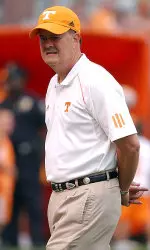
To order a print of Cutcliffe, click here.