University of Tennessee Athletics
FALL BALL SPOTLIGHT: JEFF WOOD
October 10, 2006 | Baseball
Oct. 10, 2006
By Dave Garner, UT Sports Information
The culture of American sports often neglects the unsung hero. Consider the basketball player who rarely scores but averages 10 rebounds a game.
Or, better yet, blinded by 50-yard gains, touchdowns and end-zone dances, football fans routinely glance over offensive linemen who plow defenders and open up opportunities for the running backs, receivers and quarterbacks.
If one were to peer even further behind the scenes, they would discover another key component to a team's success, the athletic trainer.
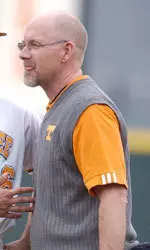
Tennessee's Jeff Wood - the athletic trainer for the Volunteers baseball team - is one of those unsung heroes.
Current third baseman Cody Brown can attest to that.
"I had wrist surgery at the beginning of last season, and I thought I was doomed," Brown said. "But he knows what he's doing, and he is always there to help. No matter what's wrong, he knows how to help."
That help paid off. Brown played in all but eight of UT's 55 games last year.
Wood, better known by his nickname, "Woody," began his training career by taping ankles in ninth grade for his high school basketball team.
And dating to those high school days in West Virginia, Wood keeps almost 30 years of training under his belt; 23 of those years include certified-training status. After high school, he attended Marshall University, where he worked as a student trainer for five years before starting the search for a career.
"I just wanted to get into baseball," Wood said. "I loved baseball although I never had any talent in it. I wanted to get into it, be involved with it, and athletic trainers were needed in baseball."
Wood began a cumbersome application process with ambitions of reaching the big leagues.
"In 1982, I wrote letters to every major league team for a minor league job," Wood said. "I received about 24 rejection notices."
Wood attributed the bad luck to a late start.
"It was late in the year, and all the jobs had been hired by then," Wood said. "But then I went into the next year early and the Baltimore Orioles called me."
Wood spent 10 years in the Orioles baseball system working in both Double-A and Triple-A leagues.
"I just saw that I wasn't going to make it to the big leagues," Wood said. "I had a wife and two kids at the time, and we were living in Rochester, N.Y., where it snowed from September to May. We had games snowed out in May."
Wood found a job opening at a clinic near Clinton, Tenn., his wife Malinda's hometown. Working there for nine years, Wood performed outreach to high schools, treated patients and even worked rodeos and NASCAR events.
A near decade made Wood weary, yearning for something new and fresh. Without a master's degree, he struggled to land interviews, much less a job. Luckily, at a Nashville convention in 2000, he ran into an old friend, the head basketball trainer at the University of South Carolina, who referred Wood to UT.
As luck would have it, the Vols were in need of a baseball trainer. Tennessee offered Wood a part-time job and paid for his master's education. He finished his degree in 2002 and was immediately promoted to full-time status.
Now entering his seventh year with the university, Wood has seen his Diamond Vols post a solid record of 190-117 in five seasons, two second-place finishes in the SEC Eastern Division, 26 Vols taken in the MLB draft and has made trips to the College World Series in 2001 and 2005.
In fact, Tennessee's 2005 CWS team found Wood as a crucial component to its run to Omaha.
"Woody was very instrumental to our success in 2005 because he did several things," Vols head coach Rod Delmonico said. "He did preventive maintenance, keeping our guys healthy and keeping them in the lineup. And when they did get hurt, he got them back in there."
With an active roster of 25, the 2005 Vols had limited depth on the bench. Despite being picked to finish fifth in the SEC East, Tennessee overcame odds to finish eighth in the nation at the season's conclusion, the program's highest final ranking since 2001.
Wood kept his team healthy enough to lead the SEC in batting average, slugging percentage, on-base percentage, runs scored, hits, RBIs, doubles, triples, total bases and stolen bases.
"I've been very fortunate," Wood said. "I've been to the World Series twice now. Coach told me earlier that year, `If we have any injuries, we're in trouble. You're going to have to keep everybody healthy.' We just had a fortunate year."
Wood's secret to success?
"We try to jump on things quickly," Wood said. "If a guy comes in with a twinge, elbow soreness, shoulder tenderness or back pain, we jump on it quickly. We try to treat it daily to take care of those deficiencies."
Being a trainer not only requires speedy care but also careful inquiry.
"A trainer, to me, is like an investigator," Wood said. "The player got injured for a reason. It's up to the trainer to find out why."
The team's recent success can partly be attributed to Wood's detective work. The entire clubhouse benefits from the care of the team trainer.
"I have a whole binder full of injuries," former second baseman Michael Rivera said. "Ever since my freshman year, Woody's been the greatest. He helped me back through all three of my surgeries."
As talented as Wood may be, his care and love for the team extends much further than just for its physical well-being.
"He's awesome," Rivera said. "He's like a dad. He treats us like his own sons. You can't ask for a better guy than Woody. He cares deeply about all of us."
Much like a father, Wood may in fact be the team's biggest fan.
"He's a great guy to have around," veteran pitcher Craig Cobb said. "A lot of people don't know this, but he's in the dugout cheering all the time. You can hear Woody over almost everybody else.
"He is just the greatest. We have guys banged up all the time, and he gets everyone in shape to be ready to play. Woody is a great, great trainer."
Woody and the Vols are currently in the midst of a three-week fall practice period. Tennessee opens the 2007 season with a three-game series at Florida State Feb. 2-4.