University of Tennessee Athletics
Athletics Director Doug Dickey
December 13, 2000 | Football
Doug Dickey's succession
of honors recognizing his achievements on the college sports scene reached
a pinnacle last winter when the University of Tennessee athletics director
was named Tennessean of the Year.
The accolade was bestowed at the annual dinner of the Tennessee Sports Hall of Fame in Nashville. Previous Tennesseans of the Year selectees had included country music stars Roy Acuff and Barbara Mandrell and Vol football coach Phillip Fulmer.
 |
| Doug Dickey |
Appearances before sports-oriented
audiences to accept a variety of trophies the last few years have become routine
for Dickey as the tangible reward for a career in which he has ranked in the
forefront of his profession as both a football coach and an athletics director.
Over a span of 36 years,
Dickey has been the principal force in University of Tennessee sports, first
as coach by winning two Southeastern Conference football championships and
since 1985 directing a Vol athletic department that has been a model of consistent
performance.
As athletic director, the
68-year-old coach-turned-administrator has been heavily involved in policy-making
on the national level. For example, in a six-year term with the football rules
committee, he served as chairman from 1992 through 1994.
Since 1992, Dickey has been
a member of the board of NOCSAE, the National Operating Committee on Standards
for Athletic Equipment. On the statewide level, Dickey has employed his administrative
skills to play a key role in the building of a Tennessee Sports Hall of Fame
in a wing of the Nashville arena. He is the Southeastern Conference representative
to the NCAA's Football Issues Committee. In addition he is on the Strategic
Planning Committee of the National Association of Collegiate Directors of
Athletics (NACDA).
Dickey's service at UT encompasses
responsibilities as head coach for six seasons (1964-69) and as athletics
director for the last 15 years.
As coach, he put Tennessee
back on the national football map with a string of productive seasons that
included league championships and bowl appearances. As athletics director,
he has overseen a huge facilities construction and renovation program.
UT under Dickey has completed
building projects that brought its physical plant to the top among major colleges
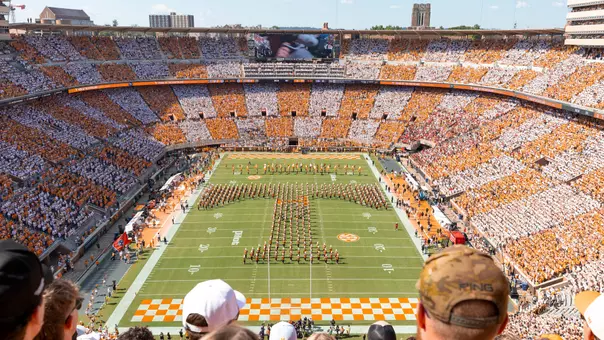
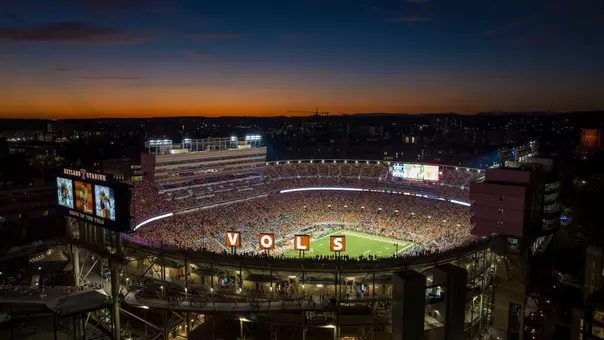
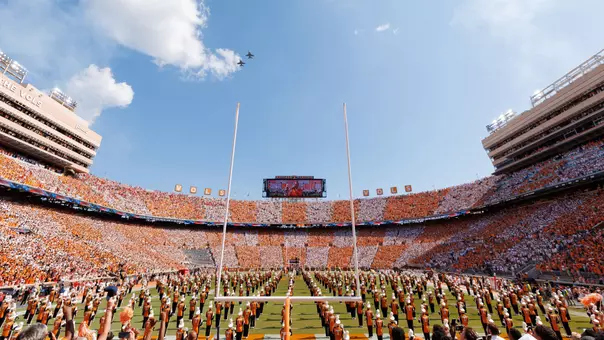
and universities. A landmark development was the opening three years ago of
an expanded north end of Neyland Stadium, bringing capacity to well over 100,000.
A UT record crowd of 107,683 saw the 1998 Tennessee-Florida game at the Home
of the Vols.
Among other additions to
the campus sports scene in recent years have been the Thompson-Boling Assembly
Center and Arena, Lindsey Nelson baseball stadium, renovated Gibbs Hall dormitory,
the Goodfriend tennis complex, Tom Elam press box and executive suites at
Neyland Stadium and Neyland-Thompson Sports Center, the name given to the
Vol football complex. Construction of 78 new skyboxes at Neyland Stadium,
on the east side, is being completed in time for the 2000 season. The Thornton
Athletic Student Life Center is slated to open in late summer.
The arena, begun under the
administration of previous athletics director Bob Woodruff and completed after
Dickey's appointment, has proved a magnet for basketball tournaments and other
events attracted by its 24,500-seat capacity.
Numerous honors have come
Dickey's way in recognition of his continuing contributions to college athletics.
He has been inducted into the Tennessee Sports Hall of Fame, the Gator Bowl
Hall of Fame and the Knoxville Sports Hall of Fame.
When Dickey succeeded Woodruff
as athletics director in 1985, he put a top priority on bringing UT's facilities
to a level that would enable Vol coaches and athletes to compete on an even
plane with their Southeastern Conference rivals. The multi-million dollar
building program was a must on his agenda.
One of his first steps was
the implementation of a well-orchestrated scholarship fund-raising drive,
which has increased UT's level of giving from approximately $800,000 to more
than $15 million annually. Contributions have increased dramatically under
Dickey's astute leadership and have been instrumental in financing the ambitious
building program.
A college football coach
for 22 years before moving onto the business world in 1980, Dickey became
only the fourth athletic director in UT history when he was chosen to the
job of overseeing Tennessee's success-oriented sports program.
Keenly aware of the role
athletics plays within the framework of the university's educational mission,
Dickey has taken particular satisfaction in allocating athletic department
funds, as available, to academic scholarships such as the Robert R. Neyland
grants, university library and the more recent Peyton Manning Scholarships.
Over the years of Dickey's administration, the athletic department has supported
academic programs in a tangible manner.
Douglas Adair Dickey brought
to the athletics director's job the qualities the university was searching
for in a replacement for Woodruff. He had long-standing ties with Tennessee,
he had been involved with college athletics for more than two decades, he
had participated successfully in business and he enjoyed a reputation for
total integrity.
Before taking the Tennessee
post, Dickey had been for four years general manager of the Florida Tile Ceramic
Centers, with headquarters in Lakeland, Fla. He previously had served the
firm as its Southeast regional sales manager.
One of Dickey's five children,
Daryl, was the starting quarterback and the most valuable player in the Sugar
Bowl after Tennessee's 1985 team won the Southeastern Conference championship.
But the current athletic director's ties to UT were forged in the 1960s when
he took a football program that had happened onto lean times and turned it
into a national powerhouse with all the accouterments of success--SEC championships,
high national rankings, a bevy of All-America stars and annual bowl game appearances.
Six years after he came to
Tennessee, a youthful head coach taking on the established greats of his fiercely
competitive profession, Dickey left Knoxville. He answered a call from his
alma mater, the University of Florida, and moved to Gainesville as head coach
after the 1969 season. His nine-year record at Florida was 58-43-2, which
combined with his six-year mark at Tennessee of 46-15-4, left him with overall
totals of 104-58-6. Dickey closed out his coaching career by spending the
1979 season as assistant head coach at the University of Colorado.
It was Woodruff, then only
a year into his athletic director's job at Tennessee, who brought Dickey,
age 31 at the time, from an assistant's post at Arkansas to the demanding
assignment as steward of the Big Orange football program before the 1964 season.
Woodruff had kept close tabs
on Dickey from the time of the latter's undergraduate days at Florida, where
Woodruff was the Gators' head coach. He detected in the lanky quarterback
of his 1953 team traits that would prove invaluable if Doug were to pursue
a coaching career. "Dickey was one of the brainiest quarterbacks I ever
saw," Woodruff told newsmen when the announcement was made in December
of 1963 that Dickey would replace Jim McDonald at the Tennessee helm.
Young Dickey, after playing
high school football at Gainesville, accepted a scholarship to the University
of Florida from Woodruff. After graduation he coached for a year at a high
school in St. Petersburg, Fla., and coached at Fort Carson, Colo., while in
the service. Then came an opportunity to join the staff of Frank Broyles at
the University of Arkansas. Over the next six years, Doug acquired a wealth
of knowledge under Broyles, coaching defense four years and then serving as
head offensive coach his final two seasons.
Doug is married to the former JoAnne Beville. They have four sons---Donald, Daniel, David and Daryl-- daughter, Mrs. Jaren Anne Wells, and 12 grandchildren.
|
DICKEY'S PERSONAL
DATA
|
| BORN: June 24, 1932, at Vermillion, S.D. |
| HIGH SCHOOL EDUCATION: P.K. Yonge, H.S., Gainesville, Fla., 1950 |
| COLLEGE EDUCATION: University of Florida 1954 |
| COLLEGE FOOTBALL: Quarterback, Florida 1950-53 |
| COACHING CAREER: St. Petersburg High School 1954; Ft. Carson 1955-56; Arkansas 1957-63; Tennessee 1964-69; Florida 1970-78; Colorado 1979. |
| WIFE: JoAnne Beville Dickey |