|
| Johnny Majors |
Tennessee legend Johnny Majors will be here at 9 a.m. Friday to answer questions in this week's live chat.
As a player, Majors was the runner up for the 1956 Heisman Trophy and was an All-America tailback.
Majors returned to Tennessee as the 19th football coach in school history in 1977, one year after leading Pittsburgh to the national championship.
Please include your name and location when posting your questions.
We'll begin at 9 a.m. and answer as many questions as we can, so be sure check back in the morning when the chat goes live.
|
 |
|
| Mark Patterson (Sebastian, Florida): Dear Coach Majors,
We first met when you came to Syracuse, NY with the Pitt Panthers football team. You were so gracious to meet me. It was a thrill for me, always will be.
I and my family have been and still are close friends of, if you may remember, great Vol #86-Buddy Cruze- and all his kids and their wives and families. In fact, young Buddy Cruze's oldest son Kyle just got married last Sunday, 10/4!
Coach Majors, my question is: What 1-3 things have you excited about the direstion Tennessee Volunteer football is taking and why?
Thanks so much!
May The Lord Bless You And Your Family!
Mark Patterson (and I know I speak for the Cruze family too in praying for God's rich blessings on you and your family) |
 |
 |
Johnny Majors: The main thing that I like most of all is the foundation that they've established. Anything you build, you have to start with a foundation first whether it's coaching or building a house. I like the foundation they've established. There's not any question in my mind that they know what they're doing in recruiting. It's a long time before the final verdict will be in on Lane Kiffin's regime, his career. He's just beginning. Building the foundation, you don't know how it's going to end up. But in my opinion, you have to start with recruiting.
You start building in recruiting and you start building a no-nonsense discipline both off and on the field. You can't have any organization without discipline and someone who knows how to coach. |
|
 |
|
Johnny Majors: They made good inroads in the first year. That should be the most challenging year of your career. You're in the process of establishing your staff. You have to have an idea in your mind who you might hire, and sometimes that changes. |
|
|
|
Johnny Majors: I think what the indications are, watching him on the field and following him, they have moved some people out of the program who they didn't feel fit in the program. I think they've established some criteria of where you can go and what lines you can't cross on and off the field. You can't do it overnight. I think they've kicked in the majority to the program.
Overall, there's no question in my mind the players have bought into the program. I played for a builder, I was a head coach at three building programs. My dad was a builder. Bowden Wyatt was a builder. Frank Broyles was a great coach I worked for. I worked for some great builders.
They're on the right track there. There's normally a lot of ups and downs building a program. Sometimes you can plateau and hit a stalemate. They've established competitive spirit, and they're already competitive on the field. |
|
|
|
Johnny Majors: They make very few mental mistakes. It will take a few years to consistent play and championship play. I know they don't want to wait that long, and maybe it will happen sooner. They make very few uncalled-for penalties, and that's a good indication. They're playing a lot of young people. It's going to cost you a few mistakes, but the foundation is being built. |
|
|
|
Johnny Majors: I've always said I was 155 pounds when I was a senior in high school.
I remember vividly after the first week of two-a-days, we had a scrimmage against the varsity. I was the starting b-team quarterback. I was playing Jackie Parker's position.
I played a big part of the scrimmage. I started, and when I got through.
We had to weigh in twice a day, prior to practice and after practice.
I weighed 144 pounds after my first week of practice.
I weighed 162 pounds as a sophomore. I know I weighed 168 pounds as a senior.
I tried very hard to reach 170. Mr. Thompson, who ran the training table, he'd give me double-egg milkshakes. Sometimes he'd give me two steaks after dinner. |
|
|
|
Johnny Majors: I'm just amazed that years and years ago, players averaged gaining 10 pounds every 10 years. Our biggest lineman was John Gordy, who weighed about 218. He was 6-4 and played in the NFL for years.
Most of our linemen were between 188 and 210. |
|
|
|
Johnny Majors: Some of the northern teams had some bigger linemen.
The Pennsylvania guys and the Ohio guys were bigger.
We were mostly like 185 with the guards and maybe a center, and 210 was the biggest. Our linemen averaged about 205 pounds. |
|
|
|
Johnny Majors: Thinking about outer space if you'd told me the linemen would be this big. I wonder how big people can get. I think someday they're going to hit a wall in the 100 meters. I don't think I'll see it in my lifetime, but I can't believe they can see it it 5 or 6 seconds. Records fall all the time. How much better can they get? |
|
|
|
Johnny Majors: How much bigger can they get? |
|
|
| Josh: At what weight did you play and how did your size compare to players of that time period? |
|
|
Johnny Majors: We didn't have any fat players. I look at pro football and college football. They could be rendered down some. I think Tennessee's rendered some of the fat off their people. I don't see many bellies hanging over belts on the Tennessee practice field. You're better off having less extra fat. |
|
|
| Mark Igou: Did you ever have a better player than Dale Jones? |
|
|
Johnny Majors: For a person who never played of down of pro football, I never had a better player than Dale Jones.
Whether they played football or not, I never had a better all-around player than Dale White with leadership attitude effort, getting every bit of energy out of a person.
I never had a person that gave more effort. More attitude. More leadership and more consistently big plays than Dale Jones in my career. He's truly one of the great players in Tennessee history.
No one is a bigger fan of that young man than me.
He was a great leader. He's incomparable from every standpoint.
There's never been a greater player than Tony Dorsett, from the time I coached for four years.
But no one could top Dale Jones from energy, enthusiasm and being a factor in virtually every game he was in. |
|
|
| JUSTIN PRATT (KNOXVILLE): Hey Coach! Are you as glad as I am to see the Orange Pants back on away games?! |
|
|
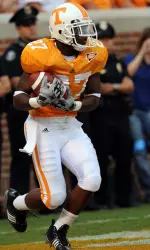
Johnny Majors: Yes. Because Tennessee had never worn orange pants until I came here. In the 30's and the 40's, until about '49, Tennessee used khaki pants. |
|
|
|
Johnny Majors: About 1948 or 49, they came in with those nylon pants. That was really quite a transition.
That was a great move. I believe it was '49 when Tennessee went to white pants, that went a long way to emphasizing the orange and white. |
|
|
|
Johnny Majors: In those days, you played in your own color, home or away. I believe the first time Tennessee ever used a white jersey was in the Cotton Bowl, the first game Harvey Robinson coached in 1951.
Tennessee had orange shirts, and so did Texas.Both of them used their orange shirts.
I was a senior in high school. That was the '53 New Year's Day game. I'm virtually certain that was the first game Tennessee wore a white jersey. |
|
|
|
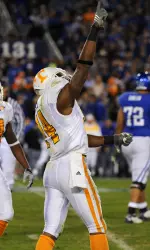
Johnny Majors: I liked the orange. It was all white. I didn't think that gave much color. I came back and wanted to look at some orange pants. The orange in the socks was different from the orange in the pants and the orange in the jersey. I ordered orange pants. I thought when you went on the road, I liked to have more orange. I think the orange pants added to that. I never liked the all-white uniform, whether it was Nebraska's all white or Oklahoma's all white. |
|
|
|
Johnny Majors: I'm no designer, but I do like color and I do like good uniforms. When you work players hard, you want them to play hard, it helps them to look good. |
|
|
|
Johnny Majors: Some of the administration wanted me to put light blue trim or black trim around the jersey.
Every year they'd bring it up. I'd say, 'I don't want to do that under any circumstances.' Tennessee's colors are orange and white. I did make the numbers a lot larger. They're more recognizable now. I'm glad to see them go back to the orange and white. |
|
|
| Scott (Blountville): Welcome Back Coach! What kind of things does a coach have to consider when deciding to switch QB's? It's more than most fans realize, give us some insight. Thanks. |
|
|
Johnny Majors: They see it every day, they know about the consistency in practice every day. They're in the meetings and know a lot more about it than I do.
I have opinions about Tennessee and other teams I watch, but I don't want to discuss that publicly.
I'm not in a position to say that. I don't that's something I want to talk about. I'm not there every day, and I don't know what the head coach and assistant coaches know. |
|
|
| Charles (Cosby): Describe your relationship with Lane Kiffin and how it feels to have him embrace you for your part in making Tennessee football what it is today. |
|
|
Johnny Majors: I like what I see about Lane Kiffin very much. I think he's aggressive. I think he's intelligent. It's quite evident he doesn't lack for confidence. I think he learned from the knee and the lap of one of the greatest coaches in football. |
|
|
|
Johnny Majors: He's got a lot of ability, a lot of potential to grown through the years.
I think he'll get the job done at Tennessee. I have no doubt about that.
He and I have a very good relationship. I don't stick my nose in his business. I enjoy going to practice, because I like watching good practices. And they know how to practice. |
|
|
|
Johnny Majors: They're being disciplined when they don't do things right, and they're being encouraged for good work and good effort. I think the players are getting great coaching.
It starts at the top, and Lane got a great foundation from his father, Monte. |
|
|
|
Johnny Majors: He played at Fresno State, a good program. He's been to a place like a lot of us to know that some don't have the resources of others. Also, he's worked for a great program at Southern Cal. He's worked at one of the toughest places to coach, in Oakland. He's got a good, diverse background. |
|
|
| barry dyesbury: coach majors you help rebuilt tn football in the late 70s and early 80s do u come to many football games |
|
|
Johnny Majors: I do now. But I travel a lot. I go to Pittsburgh, and I go to Iowa State. All the places I've coached mean a lot to me. But I played at Tennessee, I started my career at Tennessee and was the head coach here. I grew up here. I go to my hometowns a couple times a year, and I come to Knoxville a lot.
I go back to Mississippi State for nearly every reunion they have. I go to Iowa State every year for a football reunion in November. I go back to Pittsburgh several times a year. I coached there twice. I was there at their opening game. I get back a couple times a year.
Now I probably see more Tennessee games than anything. I have a good feeling about being here. I have a great loyalty for the people who helped me get to where I am.
Even though the championship teams have more reunions, I'll always be indebted to the 1968 team at Iowa State that laid the ground work. I'll always have great loyalty to the people who helped set the foundation for future success. |
|
|
|
Johnny Majors: I've always had great loyalty to the places I've coached. I know who helped me get better, and I'll never forget them. I've always stayed in contact with them and kept those relationships. |
|
 |
|
Drew Edwards: Special thanks to Coach Majors for taking the time to answer questions this morning, and thanks to everyone for asking questions, and sorry we couldn't get more of them answered. |
|
|
|
Drew Edwards: I hope everyone will be back for our next live chat after the Alabama game. |
|
|
|